Course Summary
Expiration Date: 03/26/2029
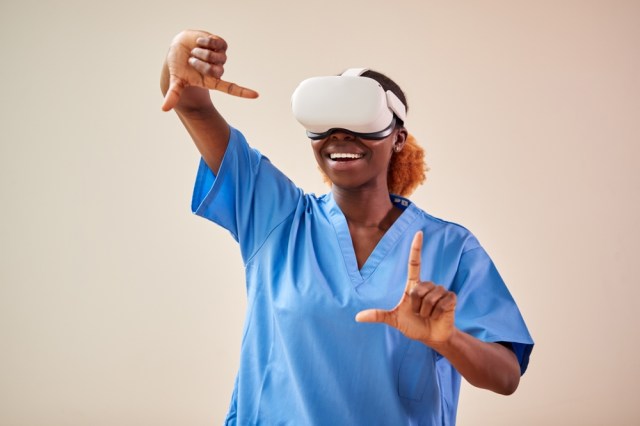
This educational activity explores virtual reality (VR) simulation as a transformative tool in nursing training, offering immersive, risk-free environments to develop clinical skills, decision-making, and empathy. It examines VR’s applications, benefits, challenges, and implementation strategies, aiming to equip participants with knowledge to integrate this technology into educational programs. Relevant to clinical practice, VR addresses gaps in hands-on experience, enhances competency in high-stakes scenarios, and supports lifelong learning amid evolving healthcare demands.
Course Format
Homestudy
Course Syllabus
- Introduction
- Virtual Reality Simulation in Nursing Training
- Models of VR Simulation in Nursing Training
- Roles and Responsibilities in VR Simulation Training
- Technologies and Tools in VR Simulation
- Section 1: Core Tools in VR Simulation
- Hardware: VR Headsets
- Software Platforms
- Section 2: Integration with EHRs and AI for Adaptive Feedback
- EHR Integration
- AI for Adaptive Feedback
- Section 3: Human-Technology Interface: Focus on Usability and Equity
- Usability
- Equity
- Benefits, Challenges, and Implementation Strategies
- Section 1: Benefits of VR Simulation
- Enhanced Skills and Performance
- Safety and Engagement
- Reduction in Burnout and Costs
- Section 2: Challenges of VR Simulation
- Cost and Access Issues
- Technical and Health Challenges
- Broader Implementation Hurdles
- Section 3: Implementation Strategies
- Pilot Programs
- Training for Educators and Users
- Curriculum Integration and Evaluation
- Regulatory, Ethical, and Future Considerations
- Section 1: Regulatory Frameworks
- Privacy and Data Protection
- Equity and Accessibility
- Section 2: Ethical Considerations
- Bias Mitigation
- Informed Consent
- Section 3: Future Considerations
- Case Study 1: Purdue Global’s VR for Readiness
- Case Study 2: Henry Ford’s Pilot for Monitoring
- Summary
Author
Allison Russo, DNP, PMHNP-BC
Allison Russo has been working in the field of psychiatry since 2009. She has enjoyed experience working in outpatient, forensics, residential and acute care settings. She has had the honor of treating Sailors across the United States and the world, serving in the Navy Reserve, since 2013. She enjoys working with clients across the lifespan. She completed her Bachelor of Science in Nursing in 2009 and Master of Nursing in 2013 at Montana State University. She obtained her Doctor of Nursing Practice from the University of North Dakota in 2016. She is passionate about collaborating with families to provide support and solve complex problems. She is excited about the use of technology, and happy to use it, to improve access to mental health care. In her off time, she can generally be found working on a remodeling project, traveling, or at the local Crossfit gym. She loves spending time with her husband, her 5 year dog, and her son.